North Star Sleep: Using Values to Break The Insomnia Cycle
One client told me she had not had a "good" morning in years. She would wake up, score the night, and immediately start sorting the day into what she could and could not handle. By breakfast, the day already felt smaller.
Most people with insomnia are doing what anyone would do. They try harder. They tighten routines, monitor every signal, and start organizing life around protecting sleep. In practice, the people spending the most energy managing sleep are often the ones arriving at bedtime already braced for a bad night.
I have treated insomnia in individual therapy and groups for about a decade, using CBT-I, the first-line psychological treatment for chronic insomnia. Over time, the same pattern kept showing up. Many of the more stuck cases looked less like a sleep-skills problem and more like an anxiety loop built around sleep.
Across clients, the loop is familiar: a rough night leads to a morning damage check, the morning verdict drives protective choices all day, and by bedtime the nervous system is already on alert for another bad night.
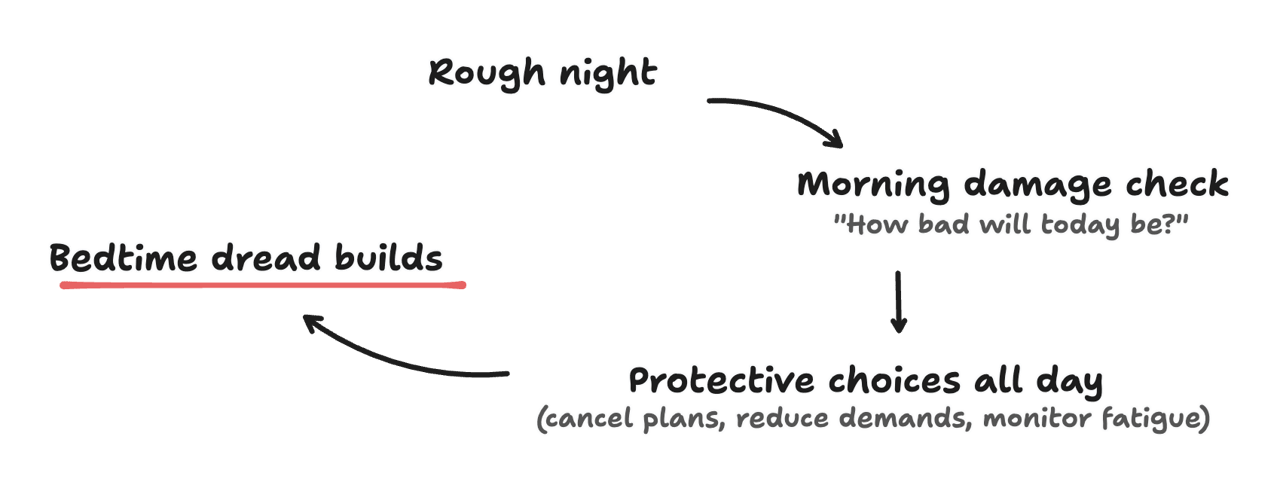
After a while, the brain starts treating two things as threats:
- uncertain sleep
- poor sleep
Once that association is in place, the threat system does its job. The problem is that a switched-on brain is bad at sleeping.
The question I keep coming back to in sessions is:
"What would today look like if sleep worry were not in charge?"
It changes what the day is about. Instead of "How do I fix this so I can sleep tonight?" the focus becomes "What matters to me right now?"
A recurring clinical pattern
A few things show up over and over in sessions:
- people often improve when sleep stops being the main project and life becomes the main project
- fear of tomorrow is often more disabling than the sleep loss itself
- cancelling meaningful parts of life after a bad night tends to make the next bedtime feel even more threatening
One example of this pattern: a client tracked sleep with two apps and a wearable, then checked the numbers before he had even gotten out of bed. That ritual set the tone for the whole day. A "bad" score meant cancelling plans, working from the couch, and dreading bedtime by noon. We shifted to one simple morning move, a 15-minute walk with his dog before any screen or sleep data. Within weeks, the morning verdict had less authority. Sleep data stopped deciding the day before breakfast.
That mismatch is common. The 6 a.m. verdict is often harsher than the day that follows once people stop organizing everything around a bad night.
This is not every insomnia case. Medical contributors matter and need proper assessment. But in a lot of persistent insomnia, fear-driven sleep effort is right in the middle of the problem.
The move is simpler than people expect. You cannot force sleep on command. You can still decide how you want to spend the day. When people start acting from values instead of fear about sleep, the struggle often drops a notch, and sleep sometimes improves in the background.
Research on acceptance and commitment therapy for insomnia points in the same direction: changing the relationship to sleep-related thoughts and feelings can improve both daily functioning and sleep outcomes over time.
In my own work, I still use elements of CBT-I. What I am describing here is one part of the picture that often needs attention as well: what happens between nights, when sleep worry starts running the day and keeps the whole system stirred up.
Values in action on low-sleep days
After a bad night, values give you something concrete to point yourself by. They help answer a practical question: who do I want to be in the next hour? If you want help with wording, use the values.guide list of values as a prompt, not a checklist.
- Fun-Loving: You slept badly and still meet friends for an hour instead of cancelling on autopilot. You may feel flatter than usual, but you showed up for the friendship instead of letting sleep worry make the call.
- Industrious: You do one focused 25-minute block on your top task rather than spending the morning checking how tired you feel. Often that first block goes better than the 7 a.m. forecast said it would.
- Loving: You still do bedtime reading with your child even with low energy. The child does not need a polished version of you. They need you there.
- Mindful/present: You notice "I will not cope," name it as a sleep-fear story, and return to the next concrete step. The thought can come along. It does not get to steer.
This is not "ignore your body"
A values-first approach does not mean grinding through exhaustion. If you are genuinely sleepy, rest. If your body needs a short nap, take one. The real shift is from fear-driven protection back toward values-led living.
The difference is practical. Lying down because you are sleepy is listening to your body. Cancelling dinner because you slept badly, just in case you might feel worse later, is sleep worry planning the day for you. One responds to what is happening now. The other is fear making decisions in advance.
Common sleep-effort decisions (and what to do instead)
These are common points where sleep worry starts driving behavior. Ask yourself the key question: "What would today look like if sleep worry were not in charge?"
| Sleep effort | Values-led alternative |
|---|---|
| "I slept badly, so I should cancel dinner with friends." | Go for 45 to 60 minutes, then leave early if you need to. Let the real evening, not the morning verdict, decide. |
| "I feel tired, so I should delay important work until I feel better." | Start one 20 to 25 minute focused block. See how the block goes before you write off the whole day. |
| "I should go to bed extra early tonight just in case." | Keep your usual wind-down. Stay up until you are genuinely sleepy, then go to bed. |
| "I need to keep checking the clock and my sleep stats to stay in control." | Move the clock out of sight. Check the data once the next day if you really need to, then return to what is in front of you. |
If you want to track these patterns day by day, the Sleep Effort Discovery worksheet gives you a short 7-day log for noticing sleep effort, naming the short-term payoff, and choosing one values-led next step. It takes about 5 to 7 minutes.
Practical plan
Keep it simple.
Keep a stable wake time Wake at about the same time, even after a rough night. Skip the morning sleep autopsy and move into the first thing you planned to do.
Notice sleep effort At the end of the day, ask: "What did I do today mainly because I was trying to fix sleep or protect myself from a bad night?"
Common examples:
- cancelling meaningful plans only because of poor sleep
- repeatedly checking tiredness, the clock, or sleep data
- postponing normal life until you "feel ready"
Then ask: "What would this look like if what matters to me, not sleep worry, were leading?"
When people start dropping sleep effort, including many sleep-hygiene rules they have collected over the years, they usually get back time and mental space for what actually matters.
Let bedtime follow sleepiness Do not force a fixed bedtime every night. Your days are different, so sleep need can vary. Keep wake time stable, wind down and go to bed when you are actually sleepy.
Bottom line
- Keep wake time stable.
- Notice when sleep worry is driving behavior, then pivot to one action that matches your values.
- Let bedtime follow sleepiness instead of forcing a fixed clock time.
You do not need perfect sleep control for life to open up again. The work is to live in a way that still feels like yours while sleep settles in its own time. When values lead and sleep effort eases off, insomnia often loses some of the pressure that keeps it going.
This guide is educational, not personal medical advice. If insomnia is severe, persistent, or creating safety risk, work with a licensed clinician.
Further reading
The idea that changing your relationship to sleep-related thoughts can improve both functioning and sleep outcomes is supported by a systematic review of 19 ACT-based intervention studies by Salari et al., The Effect of Acceptance and Commitment Therapy on Insomnia and Sleep Quality in BMC Neurology (2020), which found that ACT has a significant effect on both primary and comorbid insomnia.
This guide also references CBT-I as the first-line psychological treatment for chronic insomnia, based on the American College of Physicians clinical practice guideline by Qaseem et al., Management of Chronic Insomnia Disorder in Adults in the Annals of Internal Medicine (2016).
Want more articles like this?
Get concise guidance to help you act on what matters most.